Thursday, June 20, 2013

NeighborWorks Week 2013

NeighborWorks Week

June 1, 2013 - June 8, 2013

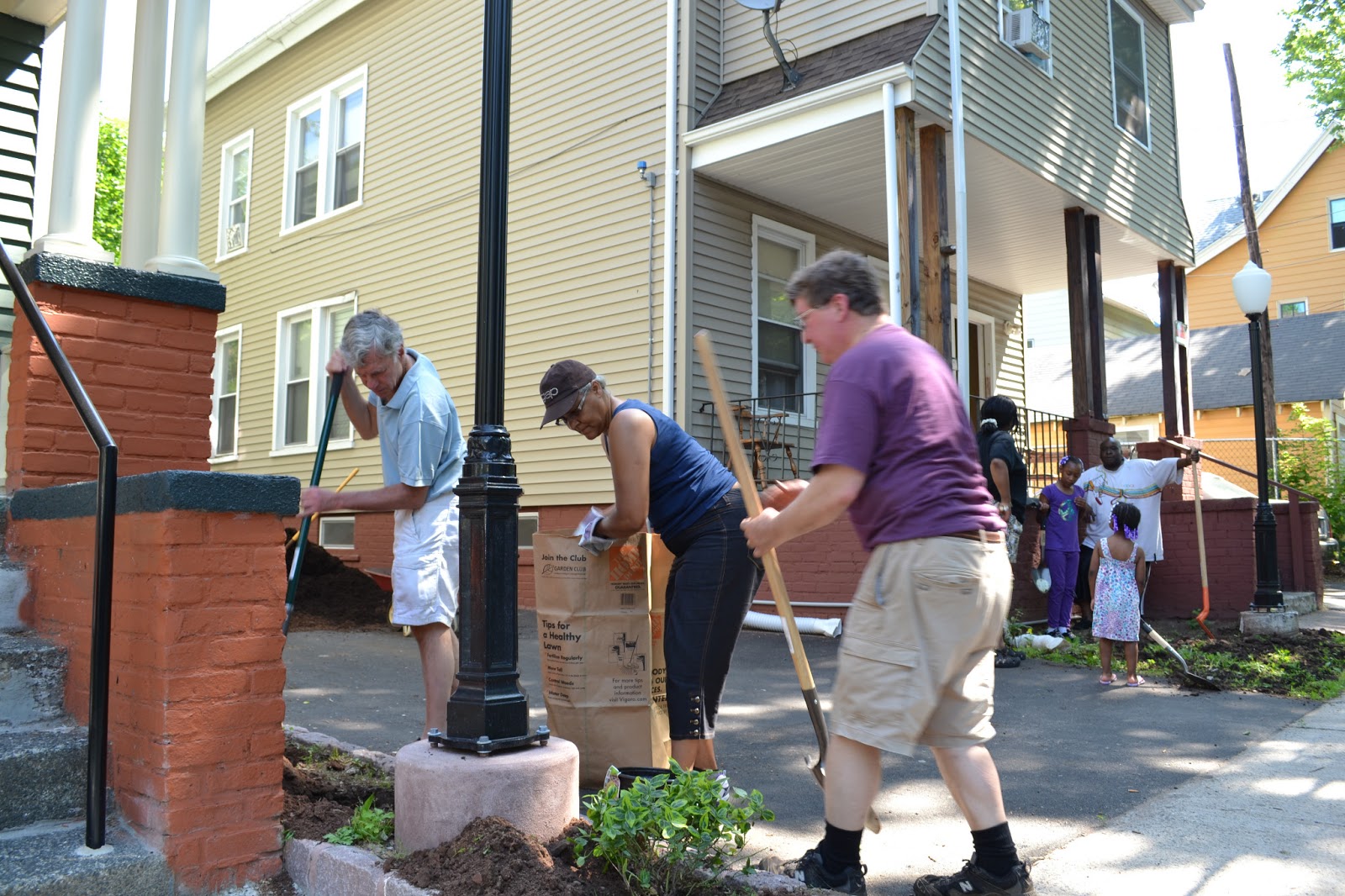
 NeighborWorks Week is a week packed with volunteer events and community engagement activities. This year's events kicked off with a street clean-up on West Division Street, followed by a week's worth of special homebuyer classes and volunteer events with Hopkins High School.
Saturday morning was a wonderful gathering of NHS staff and West Division Street residents, young and old, working together to clean, dig, and add some beauty to the street. Fortunately, we had enough tools to go around!


Monday through Thursday, NHS had the pleasure of hosting students from Hopkins High School. For three full days and a final half day, the Community Building and Organizing staff worked with rotating groups of students in their senior year who were ready and eager to give time and labor to help the community before they graduated.

It was a rough start with heavy morning rain on Monday, but the students were fearless! One group geared up with plastic bags as ponchos in order to spend time removing litter all along Sherman Avenue. Another group went door to door with flyers containing information from the city’s Urban Resources Initiative to help inform residents on how they can obtain street trees.
Fortunately, before long, the rains cleared and students were able to spend time at our future demonstration garden. Currently there is a vacant lot near our office complex that will eventually become an outdoor demonstration area showcasing rain gardens and storm water management techniques. So much progress was made because of the hard work by these Hopkins students!
 Another project students participated in was some good ol’ painting! Like any rehabilitated, older house, the NHS main building was due for some tender loving care and general maintenance. The students were happy to help us out! Deep cleaning and a couple applications of fresh paint did wonders for one of the entrances to our main office building.

While our days were active with volunteer efforts, the evenings were similarly busy with various educational classes. New Haven residents gathered each night to hear from our staff at the HomeOwnership Center to learn tips and valuable information related to becoming a homeowner. One night was dedicated to providing current homeowners with strategies on home maintenance. Another night was devoted to a special Spanish version of our Financial Fitness class. Additionally, an 8-hour homebuyer class on Saturday included a surprise cookout for lunch!
Finally, to end our resident-focused week, we held a wonderful Pancake Breakfast for NHS HomeOwners. Homeowners from NHS’ past and present met and shared stories with each other and NHS staff. This first annual event is one we definitely look forward to continuing!


Wednesday, May 22, 2013

2013 Multicultural Festival

Inherit the Earth

4th Annual Multicultural Festival

Neighborhood Housing Services of New Haven and its subsidiary, the New Haven HomeOwnership Center, hosted its 4th annual Multicultural Festival this past Saturday with its partner Start Community Bank. Since 2009, these neighboring institutions dedicated to serving the needs of New Haven residents have come together once a year to host this springtime festival meant to celebrate New Haven’s diversity.


“New Haven is a city of diversity,” said NHS Executive Director Jim Paley. “It’s part of its strength. This festival is a true celebration of life, diversity, and the spirit of the people of New Haven.”

Bill Placke, President and CEO of Start Bank, agreed. “The purpose of this event is to celebrate the Whalley Avenue community and the people who make it a great place to live and to work.”

While many of the attendees at this year’s festival were veterans of last year’s festival, many more were first-timers enticed by the festivities. Families in particular took advantage of the free food and fun offered by the neighborhood businesses and other NHS partners that sponsored the event.


Art also had a prominent presence at this year’s festival. In tandem with the “Inherit the Earth” theme, NHS of New Haven and Start Community Bank asked local students to depict what “inheriting the earth” meant to them. An art show took place on the NHS campus commemorating those who brought the expression to life on paper.
 
The festival concluded by presenting awards to individuals who have done exceptional work to improve their communities. The honorees included: Joanne Sciulli, Executive Director of Solar Youth; Mattie Stevenson, an avid community gardener; and Lanissa Gardner and Jackie Failla, two active students from Common Ground High School. All of our honorees demonstrate esteem, respect, creativity, and a love of the earth that is an example to us all.

Thank you to everyone who supported our festival and who came out to celebrate with us. We look forward to next year’s event!

Photos courtesy Tom Ficklin.


Wednesday, May 8, 2013

RLP #3 & #4 2013

RLP Recap

Classes 3 & 4: Planning Successful Campaigns + Understanding Power for Community Change


Two fantastic gatherings took place recently as part of our 2013 Resident Leadership Program: Sessions 3 and 4 of a 5 part series of classes. The first session focused on planning successful campaigns, in which we learned five important steps: 1) identify the issue, 2) define your team, 3) research the power and players, 4) develop a path to a winning strategy and 5) evaluate the campaign. Neighborhood Housing Services of New Haven’s Executive Director, Jim Paley, introduced these concepts by providing an in-depth look at his professional campaign for community revitalization through affordable housing development. Hearing the successes he has achieved and obstacles he has faced over the more than 30 years of his work in New Haven, participants were able to understand his process in the form of an interactive case-study with actual events and conditions as lessons to learn from. Furthermore, these experiences and strategies were presented in an outline format that allowed the attendees to relate information presented to their own interests and concerns. Following the presentation, the participants formed teams of five or six, to create a thorough plan for their own new, designated campaign.


With a new skill and strategies to think in terms of deliberate campaigns, our participants were geared up for the next session: “Understanding Power for Community Change.” The format for this class was a little unique as we had the pleasure to hear from not just one speaker, but four! Joining us were: Erik Johnson, the Executive Director of the City of New Haven’s Livable City Initiative; Lee Cruz, Community Outreach Director for The Community Foundation for Greater New Haven; Stephen Cremin-Endes, NHS’s Community Building Specialist; and NHS’s Executive Director Jim Paley.


The speakers did a wonderful job of providing insights into the ways in which power and opinions play vital roles in the decision making process. Stephen introduced to everyone how to create an easy-to-make and useful power mapping tool. This tool allows a user to place people in one of four quadrants: powerful and supportive; powerful and unsupportive; powerless and supportive; and powerless and unsupportive. Jim then provided some examples of how to use this tool and an understanding of how it provides the groundwork for community change. This tool is necessary to create leverage that can be applied to promote movement in a positive direction.


After this we heard from Erik who described the existing opportunities and issues currently facing in New Haven. This part of the discussion was eye-opening and allowed us to better understand how he sees progress as possible through a focus on shared values. The final discussion to this engaging session drew on Lee Cruz’s vast experience in community building. He gave both an overview and a couple of specific stories related to his work, which was beneficial for learning strategies that work in communities. Whether we’re trying to create relationships with those in a foreign community or our own, he explained, genuine interest and provoking open-ended questions are key.


Thanks to our speakers for sharing all these important ideas and techniques!


Monday, April 22, 2013

Day(s) of Caring: Wells Fargo

Day(s) of Caring

Wells Fargo Volunteer Event April 16-17

Wells Fargo has been a close service comrade of NHS this past year, and we’d like to thank them for all of their hard work! This past week they partnered with us for two days of meaningful community service.


For this Day of Caring project, we chose to have our volunteers help us out at the home of an older couple who have been working to refurbish their second-floor rental unit. With retired home owner, Mr. Garland on his road to recovery after sustaining serious injuries while working on the house, it has become clear that assistance would be needed to complete all the work that remains. That’s where the Wells Fargo volunteers stepped in!


On Tuesday, 11 volunteers from the New Haven Wells Fargo region took to painting, scraping, sanding, and pulling up old vinyl tiles in the rental unit. Our group of lady painters was of the highest caliber, as not one smudge occurred in any of the three rooms requiring trim work and multiple coats of glossy paint. Several more hardworking guys took on the kitchen tile. Slowly but surely, they ripped up four layers of flooring to expose the original wood floors underneath. The team then pressed on to the stairwell, which hadn’t been painted in years and needed a fresh coat to pass inspection. Despite some precarious heights and balancing situations, the group was fearless under the leadership of Kim, the Vice President and District Manager of the New Haven Valley branch bank, leaving beautiful work in its wake.

The next day, a group of 7 Wells Fargo volunteers undertook finishing touches and outside work. Half of the group took to the yard to sand and seal the fence straddling the property line. It was in need of some extra care for upcoming seasons, and the volunteers saved the homeowner weeks of labor. Meanwhile, within the house, other volunteers finished up the trim work in certain areas of the house. One woman took a heat gun to over four layers of paint that the house had acquired in its hundred years of existence. Another brave soul finished repainting the ceiling of the stairwell and other small, out of reach details that the previous day’s team couldn’t get to. A lot of ladder-holding and teamwork was needed, but in the end, the team prevailed! At the end of the work day, three members of the team painted the stairs in the stairwell as the final bit of work. They literally painted their way out of the house!

Wells Fargo, thank you so much for all of your hard work and expert hands! It’s always a joy having such capable people help out with challenging projects in our communities, and Wells Fargo really knew how to do things right. Cheers to a job well done!


Wednesday, April 10, 2013

I Wish We Had...

I Wish We Had...

Lilac Street Engagement on April 6th


What a great time we had this past Saturday in Newhallville! If you were in the area between 10:00am and 4:00pm you should have seen, and heard, some positive activity happening on Lilac Street. With Yale students, some of the NHS staff, local DJ Tootske, Lilac Street residents, a group of volunteers, and neighboring passersby all present, we had the street hopping!

Over the past few weeks, a few of our staff here at NHS have had the opportunity to meet with 1st year Yale architecture students as they prepared a community engagement project. Meeting community members and hearing input from the residents of Newhallville was important for these students, as they are currently designing a house that will fit on a sliver lot (30 feet wide or less). Every year Neighborhood Housing Services of New Haven partners with the Yale School of Architecture for one of these design projects. NHS obtains a vacant lot, and then Yale architecture students propose plans for a house to be built on that lot. We select the design we feel will best integrate with the neighborhood, and then the Yale students play a big role in the construction and landscaping of the house. Like all of our houses, the Yale Building Project will end up as the home of a first-time homebuyer. The vacant lot at 32 Lilac Street will be the location of the 2013 Yale Building Project, but we know that there are many vacant lots throughout New Haven that are not destined for houses or for anything at all. The Yale architecture students structured their community engagement project so that it would open discussion within the neighborhoods to brainstorm the possibilities for these vacant lots. The students also wanted to encourage residents to speak up about what assets they would like to have in their neighborhoods.


The collaboration that took place to make this project happen was fantastic to see. Students talked and met with key city officials and a few vocal residents to hear their ideas about having a street event. Engaging chalkboards were made and set-up on Lilac Street with open-ended statements for residents to fill in, such as “I wish there was ___ in Newhallville,” “I wish our block had ___” and “I wish this (vacant lot) was ___.” From what we gathered, people would love Newhallville to get the following: jobs, gun control, a teen center, an arts building, and educational programs. While there were some great ideas made by parents and other adults, the responses, and pictures, that were provided by the children of the neighborhood were amazingly creative. One contribution from the younger generation included a request for a dirt bike park! Everyone truly enjoyed the music that played throughout the day. Best of all, this was a fantastic opportunity to connect with local residents and see what they want most in the neighborhood they call home. It was great to see so many people out and about!

If all this wasn’t enough, we also had volunteers doing projects in the area while the Yale students engaged residents with their chalkboards. Yale Dwight Hall offered their hands and sweat to help NHS in our ongoing efforts to help local residents obtain front yard light posts. These lamp posts add beauty and safety lighting to the yards of these residents. The amazing volunteers from Yale Dwight Hall spent the better part of four hours digging the holes and trenches for these lamp posts.

At the same time, a few other Yale students volunteered to apply a fresh coat of white paint to the front porch of a Lilac Street house. The students chatted up residents and spruced up the porch until it looked striking and appealing. By making porches more attractive, we hope to get people to spend more time on their porches, engaging their neighborhoods and connecting with each other.


Thank you so much to the volunteers who came out on Saturday and made our events such successes! We look forward to more activities like this in the future.
What do you want in your neighborhood?


Thursday, April 4, 2013

RLP: Leslie Radcliffe

Needs and Assets

The Second Installment of Our Resident Leadership Program


In the second unit of this year’s Resident Leadership Program (RLP), Leslie Radcliffe took center stage. A longtime resident of the Hill neighborhood, Leslie is a tried and true community leader who never hesitates on taking the lead in her community. As an instructor in our RLP, her take-charge attitude fully engaged our participants.

Leslie started the class with an exercise in active listening. Participants interviewed each other for five minutes each and, without taking notes, had to summarize their partner’s traits to the rest of the class. This activity emphasized the importance of truly listening to another person, instead of focusing on wording your reply to their words.


Group participation was vital to this class, and no one shied away from addressing the group. Class attendees defined the word “assets” (“an advantageous resource”) before mentioning some general assets of their Connecticut communities.

The class then broke up into smaller groups to address questions of needs and strengths in their smaller communities. Leslie encouraged the groups to compare these lists, making connections between an identified need and a recognizable strength in the community. For example, if one list cited the need for safe gathering places, the class pointed to another list that celebrated churches and libraries and wonderful gathering places. It is important, Leslie pointed out, to take stock of all that your community has to offer and focus on its positive attributes, before dwelling on what your community lacks. You may be surprised to discover that your needs are not impossible to satisfy when you remember that your community has assets like alderpersons, local businesses, and a sense of connectivity.

Afterwards, the class watched a brief video: a case study of Savannah, Georgia. In the 1970s, Savannah was suffering due to deteriorating housing stock, a lack of safety, and a loss of culture. “We were losing our community,” one Savannah resident remarked in the video. When the city shifted gears and urged Savannah residents to take charge of their neighborhoods, however, residents became aware of just how many assets they had at their disposal. Long-standing connections among residents became the building blocks of neighborhoods eager to revitalize their communities by engaging City Hall and each other. In its current state, Savannah looks much different than it did in the 1970s, and the residents are still rallied around the power of community organizing.


Class participants then had a lively discussion of what a community should tackle first – its needs or its assets. This led to a chicken-and-egg discussion that eventually concluded on a note of balance and moderation. Needs must first be identified, true, but once the assets available to the community are laid out, the need may be further refined or expanded. Needs and assets are a continuous interplay essential to all community organizing. By staying positive, though, great things can happen.

Thank you to all of our RLP participants and to Leslie for making this class exciting and memorable!

Wednesday, April 3, 2013

Earth Day? Why Bother?

Earth Day? Why Bother?

By Henry Dynia, Director of Design and Construction


We have been hearing about Earth Day since it was initiated in 1970 as part of the environmental awakening during the second half of the 20th century. Although the history of the environmental movement runs much further back in our history, by the 1960s our industrial prosperity had created a legacy of environmental degradation: choking air, filthy water, waste washing up on beaches, burgeoning landfills, acid rain, rampant sprawl, and all the related health problems. We addressed these visible aspects of the environmental problem but were largely unaware that an invisible, odorless menace was a part of the emerging threat to our planet.

Way back from the early days of the modern environmental movement, a small community of scientists was concerned about the concentration of carbon dioxide in the atmosphere. Over the years the levels have risen far above historic levels. Pre-industrial levels of CO2 were around 280 PPM (parts per million), and now they are headed for 400 PPM, higher than anytime in the last 650,000 years. CO2 levels continue to rise more rapidly than anyone has predicted.

Why is CO2 a problem? Although CO2 will not kill you like other pollutants, its global effect on the planet is extremely damaging because of its impact on the earth’s climate. CO2 traps the sun’s heat in our atmosphere and raises the earth’s temperature. This drastically affects the habitats of all forms of life while also causing disruption and extinction. It has, and will, influence agriculture, food supplies, transportation, industry, the economy, and even where we choose to live.

You may ask: What does this have to do with me? It has everything to do with each one of us, since, in addition to being the victims of this problem, we are also the cause. Almost everything we do has what is called a “Carbon Footprint.” What we eat, wear, drive, purchase, discard, live in, work in, and do (including breathing) releases carbon into the atmosphere. Therefore, the goal is to reduce, as much as possible, the amount of carbon that results from our choices and lifestyles.

Remember, each of us is one of 7 billion people on the globe. Although the impact of our choices may be tiny in relation to the problems, it is important to take advantage of the choices that are available to us to reduce our personal impacts. One by one, those impacts and better choices will add up to make a difference. It will take an increased awareness by people around the world to pull us back from the brink of what could be potentially life-threatening.


Almost everything we do involves choices. We don’t have to sit in the dark to make a difference in energy usage, either. Use more efficient lighting, of which there are now many more products available. Purchase smaller vehicles, walk, ride bicycles, and use public transportation options if possible. To save money while also reducing your carbon footprint, use composted leaves and garden “waste” instead of plastic bags of peat moss. There is always more that we can do to our homes to make them less energy-consumptive. But there are also lots of good choices to make that can have an immediate benefit; sometimes it is as simple as turning off an un-needed light or appliance, or opening a window instead of running the AC. Each individual needs to begin to understand his or her own impact and how carbon footprints can be reduced with minimal impact, and, most importantly, how to have fun doing it! – Henry Dynia

Neighborhood Housing Services Logo

Neighborhood Housing Services Logo
NHS Logo

CB&O Weekly Newsletter Ed. 6 (July 31 – August 10)

NHS Sixth Newsletter by Will Taft on Scribd