Showing posts with label NeighborWorks America. Show all posts

Friday, June 9, 2017

June is National Homeownership Month!

A FOUR-POINT STRATEGY TO REVIVE HOMEOWNERSHIP


It’s not looking good for homeownership these days. According to the U.S. Census Bureau, 63.7% of households owned their homes at the end of 2016, down from a peak of 69.2% in 2004. While there have been small increases in recent quarters, the homeownership trend since the financial crisis continues to veer downward. We need to reverse this pattern, and these four strategies will help.

First, we have to demystify the process. 

More than two-thirds of adults in an Oct. 2016 national household opinion survey from NeighborWorks America described the homebuying process as complicated. Our network’s counselors report that a common refrain from customers they help to achieve homeownership is, “I never thought I could do this.” Because the purchase process is so complex, many potential homeowners don’t even try, essentially self-selecting out of their piece of the “American Dream.” 
Increasing the homeownership rate in New Haven, CT will energize the local economy and create jobs from construction to retail.

Second, we have to return to rational credit standards.  
 

We return to the loose underwriting of the early 2000s. However, right now, credit standards are too tight and thus reduce the prospects for homeownership for many. A recent article by the Urban Institute noted that innovations in credit scoring practices could help up to 3 million first-time homebuyers across the country. The lending industry must seriously pursue such modifications.

Third, we need to do a better job in reaching out to low- and moderate-income consumers.

These are the first-time buyers of the future and they are unsure about the path to homeownership. Nonprofits housing organizations have had a “field of dreams” mindset: if we’re here, homebuyers will find us. That’s not working. The NeighborWorks survey mentioned above also found that fewer than 10% of consumers think of nonprofit’s like Neighborhood Housing Services of New Haven first when considering how to achieve homeownership. Our organization and others working to increase homeownership, especially among first-time buyers, need to behave more like businesses and seek out these types of customers. Word of mouth isn’t enough.

Fourth, we must overcome financial obstacles. 

Home prices are increasing in nearly all markets. Here in New Haven, the median price is approximately $160,800, and the stereotypical 20% down payment is out of reach for most first-time buyers. However, the truth is, consumers don’t need a 20% down payment to purchase a home these days. In some cases, just a 3% down payment is required. However, not every lender offers flexible mortgages. 


By working with Neighborhood Housing Services of New Haven and other housing nonprofits, consumers will learn about the lenders who offer 3% down-payment mortgages. In addition, they also will be made aware of the potentially millions of dollars in down-payment assistance funds available in this community and others. The NeighborWorks survey showed that only one-third of consumers are aware of down- payment programs for middle-income buyers. 

While there isn’t an unlimited supply of down-payment assistance, if more consumers knew to seek it and sought information from nonprofit organizations, the homeownership rate would increase. That’s good for individuals, families and Greater New Haven.

###

Tuesday, June 6, 2017

NHS Kicks Off NeighborWorks Week 2017!


On Saturday, June 3rd, NeighborWorks America officially kicked off their NeighborWorks Week events around the country. This year's theme is NeighborWorks Works!

NeighborWorks Week is a nationwide celebration of the good that comes out of neighbors working and playing together. Neighborhood Housing Services of New Haven and the entire NeighborWorks network are committed to bringing about positive change by improving lives and strengthening communities. NHS is helping residents thrive in New Haven, ensuring that the core needs of individuals are met by listening to our neighbors, no matter their income or professional position, and providing or linking residents to essential services.

This year, NHS of New Haven's volunteer event was themed "NeighborWorks Works for Veterans!"

Staff from both NHS and Save the Sound (a local nonprofit that aims to protect and improve the land, air, and water of Connecticut and the Long Island Sound) came together at the home of veteran, Loreen Lawrence, to make minor repairs and additions which included: sanding and staining a wheelchair ramp at the back of her home, landscaping in the front and backyards, as well as installing an eco-friendly rain barrel, storm drain and rain garden.

We simply cannot thank Kendal Barbery (Save the Sound) and her staff enough! Kendal worked the entire week prior to our kickoff with senior students from Hopkins School in order to prepare the rain garden installation. Kendal was also kind enough to teach the Hopkins Students (and NHS staff) the intricacies of designing and building a system that connects the gutters, rain barrel, storm drain and rain garden. The project will help diminish storm water runoff in the West River and the Long Island Sound and help prevent raw sewage from entering the water system unfiltered. 

At the rear of the home, NHS staff worked diligently on landscaping, as well as performing simple and small repairs to the wheelchair ramp and backyard deck. Staffers also managed to fit in time to stain the deck with a special traction paint.

The work is far from done, but NHS staff members are so proud to have been able to help a Veteran homeowner enjoy her home just a little bit more, become more environmentally savvy, and have a gorgeous deck to relax on. We look forward to a few more volunteer events at Loreen's home.

A few pictures of the event are below, and more can be found on our facebook page: www.facebook.com/nhsofnewhaven.


Friday, April 7, 2017

April is Financial Capability Month!

Emergencies don’t have to be financial disasters; start saving now! 


You’re laid off at work. Your car needs a new transmission. Your furnace blows. These are all costly emergencies that can’t usually be anticipated and cannot be avoided once they occur. Without a fund set aside just for such emergencies, they can trigger even greater disasters.


Last year, NeighborWorks America released the findings of its third annual consumer finance survey. Chief among them is the alarming fact that nearly a third of adult Americans (29 percent) have no emergency savings. Ninety-one percent of those with incomes of $100,000 reported holding emergency savings, compared to just 30 percent of who earn less than $20,000, 63 percent of those with incomes below $40,000 and 78 percent of those with incomes between $40,000 -$50,000.


A good rule of thumb is to have enough funds set aside to cover three to six months (some say four to seven) of living expenses. This will give you enough time, for instance, to find a new job or supplement your unemployment benefits until you do. However, anything in the bank is better than nothing — and $500 will get you out of many scrapes that would otherwise put you in the hole. In other words, start small if you have to, but start.

Here are a few tips:

Set up a savings account just for this purpose. Separate it from the accounts you tap into on a regular basis so you’re not tempted to dip into your reserves. Do not get access to it via debit card. And if you are issued a checkbook, hide it.


Arrange the automatic deposit of a portion of your paycheck into that savings account. Most employers allow direct deposits into multiple accounts. This is the most painless way to create a regular savings habit; you won’t even notice it! But make sure you’ve created a realistic budget. Otherwise, you’ll be pulling money out of savings regularly to pay bills, defeating the purpose.


Keep the change. When you get $1 and $5 bills after breaking a $20, drop some in a jar at home. When the jar fills up, move it into your savings account. And if you have money left after paying your bills at the end of a pay period, move some into your emergency fund.


Save your tax refund. The average refund is in the thousands, which can give a good boost to your emergency savings. When you file your taxes, consider having your refund directly deposited into your emergency account. Alternatively, adjust your W-4 tax form so that you have less money withheld, and direct the extra into your emergency fund.


Cut back on costs. If you’re still falling short on saving, track your spending for a month to find discretionary expenses you don’t really need. Meals out, stops at coffee shops, drinks with friends all add up fast, but you may not realize how much you’re spending in total until you’ve put it on paper. Remember: Expenses you should be able to anticipate, such as holiday gifts and annual auto insurance payments, are not emergencies! One of the most common problems people have with emergency funds is forgetting to plan for one-time expenses each year.

Remember: NHS of New Haven housing specialists offer financial education and coaching to help you follow these guidelines. Emergencies are upsetting enough. Don’t allow them to turn into financial catastrophes as well.

Tuesday, January 10, 2017

Little Known Facts About the Woman Who Inspired NeighborWorks!

Discover some little-known facts about the woman who inspired NeighborWorks

Gabrielle Sims, former community scholar | 1/6/2017 11:59:47 AM (original article featured on NW.org)

A mural depicting Dorothy Richardson and local children is a prominent feature in Pittsburgh.

I recently had the opportunity to conduct research on the life of Dorothy Richardson, the guiding light for NeighborWorks America. When I started, I wasn’t expecting to learn much new about her life and what motivated her to save her Pittsburgh community. But by the end of my project, I had uncovered a lost history of a true American mover and shaker—an individual whose legacy has ensured that millions have access to the resources necessary to own their homes and build their communities. This project was far beyond what I imagined my experience with NeighborWorks America would be like and I am extremely grateful for the support I received every step of the way. 
 
My first encounter with the Dorothy Richardson story was at the orientation for community scholars in late May. Our orientation leader played a video showing a black housewife who banded together with other women in her community to lobby the banks to give them $750,000 to save deteriorating homes in their neighborhood. The story was interesting, but I had the feeling there were parts of it missing. I figured that information about her life was limited because most of her work was during the 1960s.
 
Although I was new to NeighborWorks America as a community scholar intern, there was something about the story that was so intriguing to me that I became deeply invested in learning more, beyond the bare facts. I knew Dorothy had to have done something incredible to inspire a national organization like NeighborWorks, because from my knowledge of American history, the 1960s was not an era when banks were eager to form relationships with black women, especially those living in low-income areas.
 
Fortunately, one of my assignments for the summer was to find out more about Dorothy Richardson because my supervisor, Bernadette Orr, agreed the story wasn’t as fleshed out as it could be. Bernadette warned me that others at the organization had tried to look into her story before, but didn’t come up with much more than we already had. With this in mind, I tailored the goals for the project so I wouldn’t be disappointed if I wasn’t able to answer the questions that really piqued my interest.

The gravestone for Dorothy's husband, Louis
Initially, I had three goals for finding out more about Dorothy Richardson: Discover her real birth date, who her husband was and what it took for this woman to establish the first Neighborhood Housing Services. (Yes, some basic facts were unknown!) 
 
Over a period of eight weeks, I uncovered more information about Dorothy than I expected. Every newspaper article, photograph and original document I found excited me. I began to understand how Dorothy Richardson’s work enabled a relationship with banks and learned many tidbits about her life and personality. For example, I learned that she mobilized hundreds of women in her organization, Citizens against Slum Housing, to hold sit-ins and protests. She was not at all the quiet woman she appeared to be in the pictures hanging in the NeighborWorks office. As a young, African-American woman with a deep devotion to my roots, Dorothy’s work inspired me and served as another reminder of the struggle it took for our country to come as far as it has.

Randy's colorful home
Toward the end of my time as a community scholar at NeighborWorks, my research took me to Dorothy Richardson’s neighborhood in Pittsburgh, where I interviewed people who knew her, visited her home and learned about the impact the Pittsburgh NHS has had on the community. Being on the ground in Pittsburgh made me “feel” everything that Dorothy Richardson was fighting to preserve. Randy, who owns a brightly painted home known by locals as Randyland, described how the Pittsburgh Neighborhood Housing Services (NHS) helped him purchase his first home nearly 45 years ago. He told me that although he was ostracized by others throughout his life for being "white trash," Dorothy Richardson and the other women associated with the Pittsburgh NHS always treated him like family.
 
Although there are parts of the Northside neighborhood that are beginning to gentrify, the culture and the pride of those native to the neighborhood reign. The lesson that stuck with me after I left Pittsburgh was that Dorothy Richardson knew what is at stake if a community is lost. She knew that a community brings a sense of identity to its residents and is a place where people cultivate their dreams and raise their families. She knew these intrinsic values must be defended and was able to use the eloquence of her words and her relentless passion to evict predatory landlords from her community.
 
To have the opportunity to uncover the history of such an inspiring woman was an honor. So much of the African-American story requires learning more about the stories our history books leave out. In light of the contentious events currently going on in our country, I know the struggle is not over. But people like Dorothy Richardson have paved the way for women like me to be a catalyst for change.
 
P.S. Dorothy was born on May 30, 1922. Her husband, Louis, was a section hand on the railway before enlisting in the Air Force in December 1942, in the midst of World War II.

Monday, January 9, 2017

It's That Time of Year Again...Are You in the Mood to Buy A Home?

NHS of New Haven is committed to ensuring that each and every prospective homeowner goes into their purchase with their eyes wide open. Understanding the mortgage process, understanding your numbers, understanding everything that comes along with being a homeowner is what we teach best!

For a quick guide, check out this graphic created by NeighborWorks America. Or click on the  If you have any questions, you can reach out to any NHS staff member and we'll be happy to help!


NHS of New Haven is a NeighborWorks America chartered member. 

Monday, December 19, 2016

Personal Finance Tips: All About Insurance!

With the day-to-day struggles of paying bills and setting money aside for savings, it’s easy to overlook the importance of insurance. Everyday concerns also make it difficult to recognize that the insurance you took out in the past may not be the right type for today or the future.

Neighborhood Housing Services of New Haven has developed five tips to help you choose and manage your insurance needs, whether you’re a renter or homeowner:
 

1. Don’t let a homeowners policy “gather dust.” 
Most people obtain homeowners insurance when they buy their home, then put the policy into a drawer and forget about it. However, it’s best to review your policy every year and see if it needs to be upgraded. For example, if you’re doing a major remodeling project, such as finishing a basement, updating a kitchen or renovating a bathroom, the value of your home and property will change and thus your policy needs to be re-examined.

Choose a homeowners policy that covers 100% of the replacement cost, not only market value. Unfortunately, in some areas, older homes have a market value that is substantially below the replacement cost. Don’t be caught with an inadequate policy.

Building contractors or professional replacement-cost appraisers are a good source for obtaining an estimate for your home. Estimates from these sources should reflect your home's new features, like those mentioned above. NHS of New Haven can put you in contact with qualified professionals.


2. Buy and update renters insurance. 
Renters insurance protects the valuables inside your home whether you're living in an apartment or renting a house. If an incident such as a fire or flooding, a landlord's insurance will cover the building itself but not your own property. As with homeowners insurance, you should review the policy regularly to assure it reflects your current address and property. For example, if you do not alert your insurance company when you purchase an expensive item such as a tablet computer or piece of art, you might not be reimbursed if it is stolen later.


3. Manage your credit for the lowest insurance premium. 
 Just about everyone has heard about credit scores. However, many people aren’t aware that insurance companies calculate a person’s insurance score, and use that number to determine how much your annual homeowners insurance will cost.

Like a credit score, an insurance score takes into account your outstanding debt, the length of your credit history, whether you pay your bills on a timely basis, your number of credit accounts and any new applications for credit. The best insurance scores are assigned to individuals with long, established credit histories, a track record of on-time bill payments, low debt and few new credit accounts. NHS of New Haven offers post-purchase housing counseling and financial capability programs that help you manage and improve your credit score.


4. Look for ways to lower auto insurance costs. 
There are more than 250 million registered automobiles and light trucks in the United States, and the average vehicle age is more than 10 years. If you’re one of the millions of drivers with a car, there are ways to lower your insurance cost.

Most auto insurance companies offer reduced rates to drivers with clean records. If you haven’t had an accident in the last few years, check with your insurer and others and determine if your rate could be lowered.

Parents of children who drive know that adding their kids to the policy could push up the annual premium. But if your child successfully completed some driver-education courses, or earns good grades in school, alerting your insurance company could lower your auto insurance costs.


5. Purchase life insurance. 
Life insurance is a tough investment for many people, but if your income is essential to your family’s day-to-day life, then planning for the ultimate unexpected occurrence could be the right thing to do. Life insurance products are incredibly complicated, and according to an industry trade group, more than 100 million people in the United States are without life insurance protection.

Working with a financial coach at NHS of New Haven can help you set a budget that will help you manage all of your insurance needs.

Friday, December 16, 2016

NeighborWorks America Post: Helping Consumers Avoid Pitfalls of Payday Loans

Nonprofits Can Help Consumers Avoid Pitfalls of Payday Loans 

Originally posted on NeighborWorks' site. 
Written by Marietta Rodriguez, Vice President of National Homeownership Programs | 5/16/2016 

 
Payday loans are bad deals for consumers. That's why NeighborWorks is excited to see that Google announced it would no longer accept ads from payday lenders. These ads attracted financially troubled consumers and trapped them in unexpectedly long-term bad deals for short-term money.

Traditional lenders don't often offer short-term, low-balance loans people may need to cover a financial emergency in a pinch. There are lots of people who have little or no emergency savings to pay for a car that suddenly breaks down, or to replace an appliance that quits the proverbial "one day after the warranty expires." But payday loans are actually anchors that can drag consumers into a sea of debt - not stabilize their financial boat.

NeighborWorks consumer financial surveyA 2016 survey from NeighborWorks America found that more than 28 percent of adults have no emergency savings to cover these sudden costs. The Consumer Federation of America and Pew Charitable Trusts released similar results. That's one reason that payday and title loans are used so frequently. These loans often seem affordable, but when looked at closely, their costs are outrageous.

According to the Federal Trade Commission, a $15 fee for a $100 payday loan carries an annual interest rate of nearly 400 percent. And most payday loans are not for $100 but rather for $300 or more. When they are due in two weeks or less, in full, recipients must continue to borrow to pay other loans. What's more, borrowers incur overdraft and bounced-check fees when lenders run their post-dated checks through the system.

In April, Consumer Financial Protection Bureau chief Richard Cordray said the agency continues to prepare regulations for the payday lending market. These regulations are likely to incorporate an ability-to-repay principle.

The convenience of these products masks their costs, and consumers who are cash-strapped could easily see these loans as the best solution to the question: How do I get money right now? However, there is a better solution than these high-cost products, and it starts with better information and better planning. That's where financial capability coaching and counseling come in.

Managing finances orange graphic with calculator, envelope and notebookFinancial capability counseling — often provided free or at very low cost — is an approach that combines financial education, counseling and coaching. Tax season is a great time to start this kind of program and implement strategies that maximize monthly cash flow, set a savings plan and minimize the risk of needing one of these high-cost loans.

The trouble is, not enough people are aware of the availability of financial capability services, especially from nonprofit organizations like those affiliated with NeighborWorks.

In a 2015 NeighborWorks America survey, three-quarters of adults said they were unaware of free or low-cost services like financial coaching in their communities. We have to make more people aware of these services because financial capability coaching and counseling works. A project spearheaded by NeighborWorks America found that more than half of clients who didn't have savings before working with a coach or counselor had set aside a median amount of $668 after coaching. That amount goes a long way toward establishing an emergency fund. Importantly, the interaction also had a positive effect on people who already were savers. The median increase in savings for these clients was more than $900. In short, working with a financial coach or counselor helps people prepare for unexpected financial emergencies, enabling them to better avoid high-cost lending products such as payday and title loans, or the need to get their tax refund now instead of waiting a few days.

The centerpiece of financial capability counseling is looking ahead. A great first step in setting personal financial goals — whether they be allocating money for emergencies, developing a strategy to start a business or saving for college education — is to retain a financial capability counselor. It's easier to avoid payday and other high-cost lending traps if you're looking ahead.

Monday, August 22, 2016

Five Ways Gardening Feeds the Soul

This blogpost was first published on NeighborWorks' site: nw.org


Five ways gardening feeds the soul


Pam Bailey, NeighborWorks blogger | 8/18/2016 11:40:23 PM


Communal gardens have become a fixture of neighborhood revitalization and community-building programs. Whether it be individual plots in one garden or one big lot that residents cultivate together, there is a growing escalation of a phenomenon with deep roots in American history, culture—and psyche.

Statistics are hard to come by, but a report by the National Gardening Association found that the number of households participating in a community garden grew by 2 million between 2008 and 2013. Leading the swell are millennials, particularly in our nation’s urban areas.  Stats like that, along with news of hipsters flooding to bankrupt Detroit to start urban farms, can make it seem like community gardens are a recent fad driven by the foodie/locavore movements. However, not only does community gardening and urban farming pre-date the coining of the word “hipster,” but they also have so much more meaning and impact than community building and local food production—although those are significant benefits.
The glory of gardening: hands in the dirt, head in the sun, heart with nature. To nurture a garden is to feed not just on the body, but the soul. – English poet Alfred Austin
“When talking to ‘red zone’ [crisis or disaster] survivors—whether they be war refugees beginning a new life in Dearborn, Michigan; residents of New Orleans’ 9thWard after Hurricane Katrina; or homeowners struggling to hang on in a largely vacated Detroit—we often hear stories about how the act of planting has been critical to emotional survival and to engendering hope for the future,” writes Keith Tidball and Marianne Krasny in “Greening in the Red Zone: Disaster, Resilience and Community Greening."

In fact, argue the two researchers, this attraction to nature and particularly to the act of planting is biologically hardwired. “Biophilia” is the term coined to describe the “innate human predisposition to affiliate with, or to seek out, nature. “Urgent biophilia” kicks in once war, hurricane or other crisis induces a feeling of intense threat or loss. Gardening or otherwise actively communing with nature renews the emotional affiliation with other living organisms, paving the way for both individuals and communities to recover and regenerate, say Tidball and Kasny.

Here are a few of the many ways that catering to biophilia through community gardening can benefit both residents and their neighborhoods, as explored in a recent webinar sponsored by NeighborWorks America’s green program (plus one I added):

Emigration and intercultural connection

One of the most stressful experiences an individual or family can experience is becoming a refugee or other type of migrant. Displaced from the familiarity of their homeland, often as the result of traumatic forces such as war or persecution, they have multiple needs that community gardening can help fulfill.

“Most refugees have experienced a profound loss of control over their lives,” comments Katie Painter, program coordinator for Global Gardens, which works in Boise, Idaho, to help them cultivate the food they remember from their homelands, engage with the broader community and support themselves by becoming entrepreneurs. “Many also come from agrarian environments. It’s comforting to do something familiar, and it also draws them out of the perceived safety of their homes to mix with others. Gardening is an act that creates a feeling of empowerment and transcends languages.”

Global Gardens currently runs nine community gardens hosted by nonprofit partners, including NeighborWorks Boise, on land they own.


Youth engagement

Gardening is often an interest that must be deliberately cultivated among youth in urban, high-crime neighborhoods. But once they are both given the opportunity and shown the appeal, it can be transformative.

One example is a unique program in the hard-scrabble eastern side of Cleveland, Ohio, that uses hip hop to attract youth to neighborhood engagement—and has found gardening to be ideal companion activity.

The program is called Fresh Camp, explains Dee Jay Doc Harrill, a hip hop artist himself. The camp name comes from the hip hop meaning for the word “fresh”: unique, original, cool.

“Hip hop is a favorite music genre among teens, especially in the inner city,” he explains. “We use something that already attracts them to draw them into other activities in their neighborhood they don’t know they’d like.”

About five years ago, Herill recalls, the group took a walk through their neighborhood looking for what was “fresh” around them. And one thing they noticed was the growing number of community gardens in the midst of what had been a food desert, often in previously littered, vacant lots. So, Doc reached out to the volunteers who run Ashbury Sprouts, supported by NeighborWorks member Famicos Foundation. They were given nine beds to garden, and at least one of the youth chose it as his favorite activity that summer.

“They would not have signed up for gardening camp,” Herill notes. “But then they discovered how awesome a really fresh tomato tastes, and that they can fulfill some of their needs on their own, without relying on a system in which they have no faith. That they can produce their own food without depending on anyone else.”


Food justice/healthy living

A 2010 study by the Denver Urban Gardens found that more than half of community gardeners satisfy the national guidelines for fruit and vegetable consumption, compared to a quarter of non-gardeners. In addition, 95 percent of community gardeners give others some of the produce they grow to friends, family or people in need (60 percent specifically to food-assistance programs).

One focus of the Greening of Detroit is to help residents develop a healthy relationship with food through self-sufficient production and greater awareness of nutrition. Seasonal produce is grown in four hoop-house tunnels year-round. In 2015, 15,046 pounds of produce was harvested and of that, 7,315 pounds were donated to community organizations. In addition, classes on everything from “Grilling Your Vegetables,” to “Wild Edibles,” to “Preserve, Pickle and Freeze” are offered.

However, the health benefits of community gardening may extend beyond the food itself. In their provocative “Greening in the Red Zone” book, the authors share the results of large, longitudinal studies of people aged 60 and older that have demonstrated a significant association between gardening and reduced risk of dementia.


Resilience in the face of crisis

Tidball and Krasny dcument studies showing that community gardens lead to more neighbor-to-neighbor assistance in times of general need. Likewise, survey research shows that in low-income neighborhoods, community gardens are associated with an increase in organizing around other neighborhood issues, such as crime prevention.

“We believe that creating an extensive network of community gardens prior to disasters would bolster the capacity for resilience before it is acutely needed,” they conclude.


Community building

“Grow a garden, grow a community” is the motto for Feedom Freedom, a group of independent growers in Detroit. (And no, that’s not a typo! When the logo for the group was designed, a vine displaced the “r” by mistake – and the quirky name became permanent.)

Myrtle Thompson-Curtis, who visited the August community building and engagement meeting for NeighborWorks America, explains how the group got started:

“Before we were married, my husband and I both moved into the lower east side of Detroit [from other neighborhoods]. We talked about how to integrate into the community, get to know who else was there, do something to be good neighbors. There were a lot of vacant lots, and Wayne [her future husband] had both a long history of activism and a lot of friends doing gardening work. It seemed right.”

Today, they have six lots and five paid staff members, made possible in part by participation in a U.S. Department of Agriculture grant to offer children’s programming. They have a regular flow of volunteers, and have—as hoped—gotten to know everyone in the area, right down to all the inquisitive children and the “lady who sweeps the streets every morning, on her own initiative.”

“We have expanded from urban food production to education about art, foreclosure prevention and the water crisis in the area. When someone has a personal crisis, we’re a resource as well,” she smiles. “This has become a safe space, a transformative space.”  

Tuesday, August 9, 2016

NHS of New Haven to be featured in a NeighborWorks Book!


NeighborWorks America has officially announced the network organizations that will be featured in the upcoming NeighborWorks Book to be published December 2016.

AND....
Neighborhood Housing Services of New Haven will be featured in the book!

The book will consist of case studies of the outstanding work being done in community development, as well as innovative solutions in affordable housing.  The strength of the NeighborWorks network; our experience and peer to peer resources, allow us to not only leverage our expertise but together build an elite solution-based platform to improve lives and strengthen communities to overcome even the toughest of challenges.  

We are proud to not only be participating in this project but also to be a chartered member of the NeighborWorks network. 

Mark your calendars for Dec. 2016 for the book launch and stay tuned for more exciting events to come.  Feel free to share the news on social media channels using #OurNWBook

Monday, August 1, 2016

Paying for Solar: Tips for Financing a Residential System

This article was originally posted on NeighborWorks America's website. NHS of New Haven is chartered member of the NeighborWorks network.


Paying for solar: tips for financing a residential system

Elaine Ulrich, program manager, Department of Energy | 7/28/2016 11:08:57 AM


Editor's note: Just like a renovated kitchen increases a home’s value, solar can do the same. The U.S. Department of Energy SunShot Initiative’s spotlight on solar and real estate highlights a variety of resources on the subject, including this blog post with useful information for anyone who is considering residential solar or is counseling someone who is. There also is information specific to homebuilders.

After you’ve made the decision to go solar, the next step is figuring out how to pay for it. Assuming you don’t have the cash to buy your solar energy system upfront, like the vast majority of Americans, there are a variety of financing options to help you hitch onto the solar bandwagon and start increasing the value of your home.

The simplest way to get capital to go solar is through a loan, which can save you anywhere from 40% to 70 percent over the lifetime of your solar panels. These loans are similar to most home improvement loans used to complete upgrades or renovations, such as finishing a basement or re-doing your kitchen. A variety of sources offer loans, including banks and solar installers.


HomeStyle Fannie Mae mortgage


A new type of loan is making solar energy accessible to even more people. Fannie Mae’s HomeStyle® Energy mortgage gives borrowers the ability to complete clean energy upgrades up to 15 percent of the as-completed appraised property value of the home. Borrowers are able to finance energy-efficient upgrades when purchasing or refinancing a home, eliminating the need for a subordinate lien, home equity line of credit, Property Assessed Clean Energy (PACE) loan, or unsecured loan. The mortgage requires homeowners to attain a home energy report in order to show the value gained through energy savings over time is greater than the installation price tag. The HomeStyle Energy mortgage changes the solar loan landscape. It will encourage solar installation companies to revisit their loan practices, allowing for more competition within the industry and reducing soft costs—such as permitting and installation—for consumers. People buying homes or refinancing mortgages now can have the cost of a solar array wrapped into their mortgages without worrying about higher interest rates.

Regardless of the type of loan you secure, the solar on your roof is going to add value to your home. A recent study found that home buyers across the country have been willing to pay a premium of about $15,000 for a home with an average-sized solar array. Another study found homes with solar panels sell faster than those without.


Other options


If you’re unable to secure a loan to purchase a solar energy system, you still have other options. You can obtain a third-party owned system through a lease or power purchase agreement (PPA) offered by some solar installers, whereby the installer owns and maintains your system. Solar leases require consumers to pay a fixed monthly payment that is calculated by assessing the amount of electricity the system is expected to produce. With solar PPAs, consumers buy the electricity generated by their rooftop system back from the installer at a set rate per kilowatt-hour. Although these arrangements are often offered with no money down, consumers don’t benefit from the rebates, tax breaks, and other incentives available to system owners. When the time comes to sell one of these homes, data shows that even though third-party owned systems add some complexity to the real estate transaction, the overall impacts are mostly neutral.

Financing is a big part of going solar, and several SunShot Initiative awardees are working to lower these costs. Incubator awardee Sungage Financial created a marketplace that provides homeowners with easy, online access to low-cost financing for solar equipment. Pilot programs in the Northeast have helped the company understand how to meet the needs of consumers, installers, and capital providers in order to successfully and efficiently deliver financing solutions. Additionally, work under kWh Analytics’ Incubator award uses data analytics to help investors understand the perceived technical and financial risks associated with solar, which will build investor confidence and enable more capital to enter the market for residential systems.

Consumers have a lot to consider when it comes to solar financing, but the end result is worth it: cleaner, more affordable energy that has the potential to greatly increase your home’s value.


The U.S. Department of Energy SunShot Initiative is a collaborative national effort formed to aggressively drives innovation to make solar energy fully cost-competitive with traditional energy sources before the end of the decade. Through SunShot, the Energy Department supports efforts by private companies, universities and national laboratories to drive down the cost of solar electricity to $0.06 per kilowatt hour. Learn more at energy.gov/sunshot.

Thursday, June 16, 2016

Debunking Three Home-Buying Myths!

Debunking Three Home-Buying Myths! 


According to research from NeighborWorks America, 90% of consumers consider owning a home an important part of their American Dream. But the homeownership rate is falling nationally, and buying activity is simply not where it should be. That's because three major misconceptions about what it takes to become a homeowner – down payment, credit and lender approval – are combining to hold back many qualified consumers from taking the first steps towards that dream. Mortgage rates have been consistently low for a while now, but many potential homebuyers are on the sidelines because they believe the wrong facts about homeownership and what it takes to be a homeowner. 

Myth #1: "I need to save 20 percent" 
Reality: Many potential homebuyers believe they need a 20% down payment to qualify for a mortgage. Nothing is further from the truth. Lenders throughout our community have mortgages for people who have saved as little as three percent of the down payment. Importantly, there are special lending products in our market where a qualified buyer with only a three percent down payment may not have to pay mortgage insurance. Not everyone is eligible for these loans, but attending a homebuyer education workshop is the best way to learn what it takes to qualify. 


Myth #2 "I Need perfect credit" 
Reality: It's not necessary to have perfect credit to qualify for a mortgage. Although weaker credit usually means that a buyer may not receive the lowest mortgage rate available, the difference in rate typically doesn't slam the door on homeownership. Moreover, by attending the homebuyer education workshop, a consumer will learn how to most successfully find a mortgage lender that matches their credit profile. While perfect credit isn't necessary to qualify for a mortgage loan, homebuyer education will help a homebuyer manage their credit during the process. Lenders are checking credit practically up to the time of home purchase. By not paying attention to credit during this process – for example missing a single payment for 30 days – may severely damage a credit report. Homeownership counselors at NHS of New Haven work with consumers every step of the way.


Myth #3: "One lender said no, they'll all say no" 
Reality: Mortgage lenders are not all the same. One lender that says no, does not mean that all lenders will. The NeighborWorks survey found that most Americans are confident that they could find the mortgage that is right for them, but one-out-of-five are not confident at all, and two-thirds of consumers say that the entire home buying process is complicated. NHS of New Haven homebuyer education workshop is here to help make the process smoother, including helping a consumer find the lender that will help affordably get a home today and for the long-run. 


Wednesday, June 15, 2016

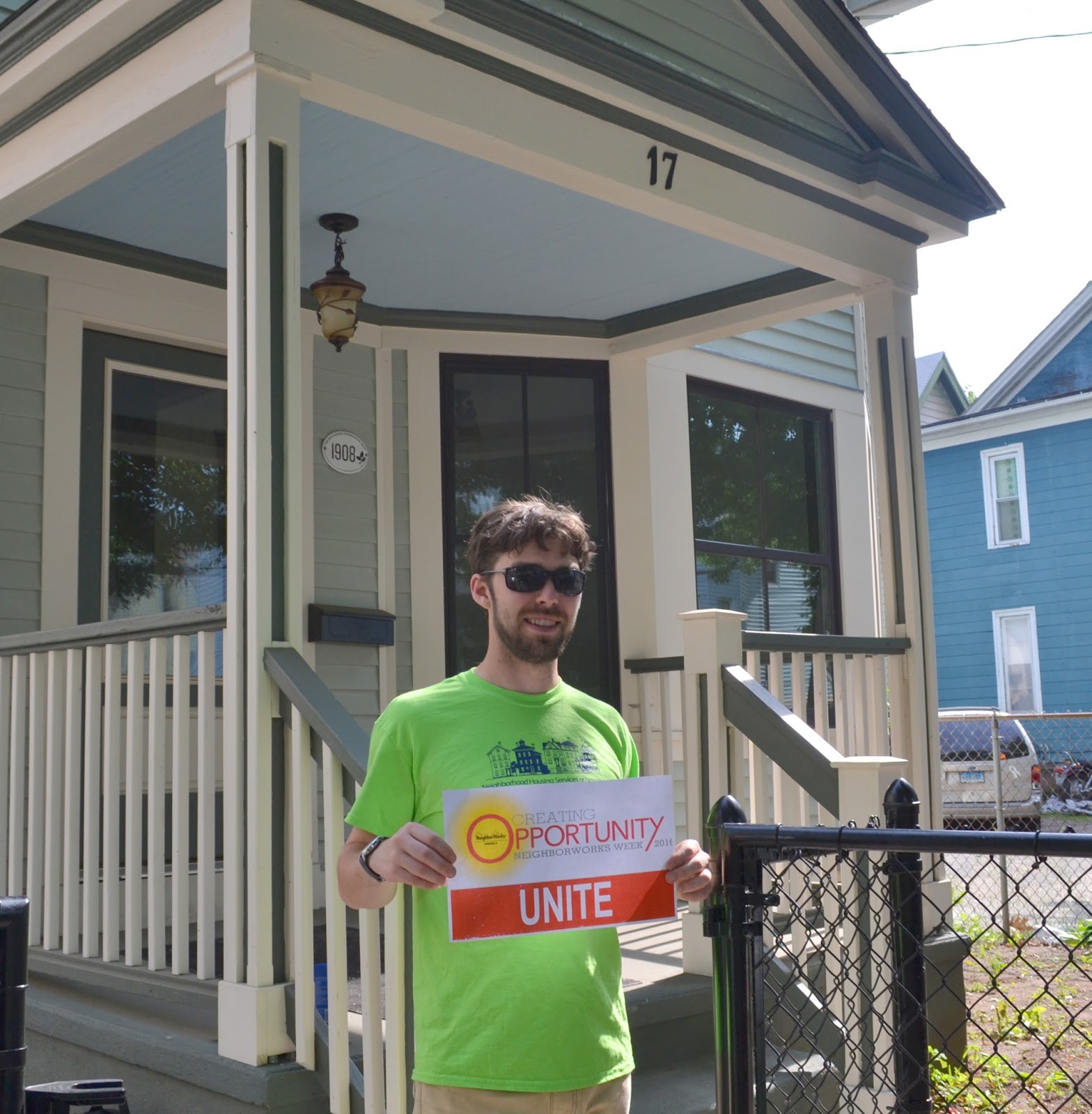
NeighborWorks® Week 2016: Creating Opportunity to Unite

On Saturday, June 11, 2016, NHS of New Haven culminated a week-long series of events and activities with a neighborhood clean up, walking tour, and open house at 17 Bassett Street in New Haven!

Huge thanks to everyone who joined us. We are so grateful for your help! We hope you'll join us again next year!


Neighborhood Housing Services Logo

Neighborhood Housing Services Logo
NHS Logo

CB&O Weekly Newsletter Ed. 6 (July 31 – August 10)

NHS Sixth Newsletter by Will Taft on Scribd